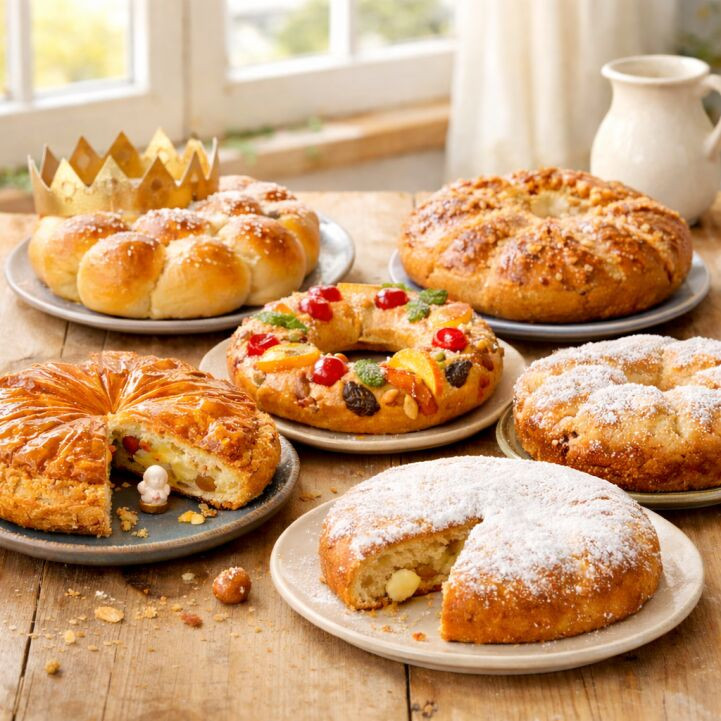
Across Europe, food traditions have outlasted borders, rulers, and religions. Empires shifted, beliefs changed, calendars were rewritten — yet people continued to gather at the turn of the year to share familiar food with family and friends. New Year moments have always been used to affirm hope, steady the spirit, and strengthen the bonds between generations.
Long before Christianity, pagan midwinter rituals centred on shared loaves and cakes shaped by the rhythm of the seasons. In Roman times, during Saturnalia, a cake baked with a hidden bean decided the “king” of the feast — a playful nod to fate, renewal, and the promise of returning light. When Christianity spread, these customs weren’t erased, but absorbed, becoming part of Epiphany while the ritual itself remained quietly unchanged.
In France, this lives on as the Galette des Rois; in Spain, the Roscón de Reyes. Different names, different prayers — the same shared table. A cake is cut, laughter follows, and for a moment the year feels open again. Through food, memory is passed hand to hand, reminding us that while the world changes, our need for comfort, connection, and hope remains the same.
Enjoy the warming food to a back drop of ice and snow this week, Steve and the Spice Team
The New Year starts with discount code
SharedCrumbs25
Good for 1 use per customer, expires Monday 12 Jan
A flaky pastry cake shared on Epiphany, with a hidden fève to bring luck for the year ahead.
Ingredients (serves 6–8)
For the filling (frangipane): 100g ground almonds 100g unsalted butter, softened 100g caster sugar 2 medium eggs 1 tsp vanilla extract 1 tbsp plain flour Optional: 1 tsp dark rum or orange blossom water
For the pastry: 2 sheets all-butter puff pastry 1 dried bean or small ceramic fève (well wrapped)
To finish: 1 egg yolk, beaten with a splash of milk
Method Make the filling Cream the butter and sugar until pale and soft. Beat in the eggs one at a time, then fold in the almonds, flour, vanilla, and rum or orange blossom if using. Chill briefly.
Assemble the cake Lay one sheet of pastry on a baking tray lined with parchment. Spread the filling evenly, leaving a 2cm border. Press the fève gently into the filling.
Seal Lightly brush the pastry edge with water, place the second sheet on top, and press the edges together. Crimp gently with a fork.
Decorate Brush the top with egg wash, then score a light sunburst or spiral pattern with the tip of a knife (don’t cut through).
Chill again Rest the assembled galette in the fridge for 20–30 minutes — this helps it rise cleanly.
Bake Bake at 190°C (170°C fan) for 30–35 minutes, until deeply golden and puffed.
Serve Let it cool slightly. Traditionally, the youngest person hides under the table to decide who receives each slice — an old ritual to let fate choose fairly.